






By Simon Buddle, Future Ready Homes.
Thursday night used to be quite a special TV night in the UK in the 1970s and 80s. Top of the Pops, the Old Grey Whistle Test and, of course, Tomorrow's World. Many of you will have seen the 1989 Tomorrow's World that was recently shared via social media, showing us what technology we might have in our homes today.

The fact that much of what was anticipated is now commonplace in a KNX home in the form of automated blinds, heating and reactive windows, is testament to how accurate those predictions were. The focus on reducing our fossil fuel consumption through better efficiency was particularly prescient - indeed a recently-finished job used the then-futuristic Aerogel to insulate a staircase on a four-storey external wall. The only exception is that whilst there are some inductive charging devices around, we've yet to see them embedded in the walls.
Powering
KNX
The need for accessible power is also pertinent to KNX. The
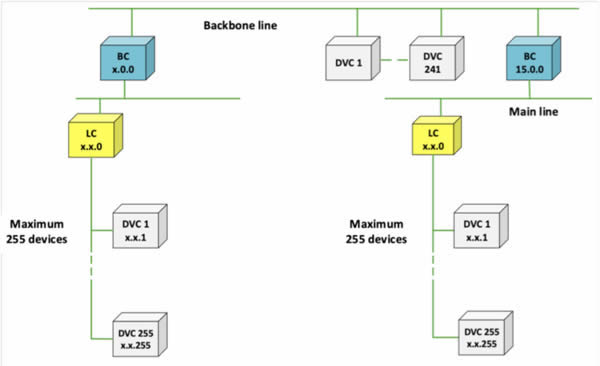
introduction of the KNX TP1-256 topology last year basically means that a total
of 256 devices can be connected to a single line without the need for line
repeaters. KNX TP1-256 has meant, for many, that we can largely forget about
topologies, line couplers and power supplies - and I'd tend to agree when it comes
to small systems - but there remains a good argument for creating separate
lines on larger projects to protect the system against a single point of
failure.
We are also seeing some new products come onto the market
that don't require a 230V supply to power them. This is great in terms of
easier wiring in the control panel, but it does come with a trade-off in that
the bus current draw is often higher as a result, since all the power to drive
the devices' circuits and relays comes from the bus rather than the 230V
supply.
Bus power
Just look at this example in order to work out just how
quickly you can run out of power on the bus. Let's say we have a total of 15
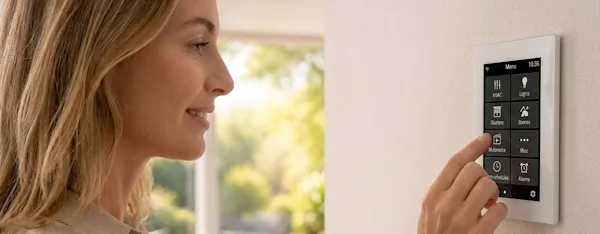
rooms, each with a capacitive touchscreen keypad on the wall. These are rated
at 20mA bus maximum consumption. Now add in, for each room, a radiator servo
valve actuator also with a rated consumption of 20mA. With those 30 devices
alone, we've instantly used up 600mA of our PSU, and that doesn't take into
account anything back of house in the control panels. Now, a good rule of thumb
for specifying a PSU is to only ever drive it at 80% of its capacity. That
means 512mA maximum for our 640mA PSU. I realise that typically they won't all
be drawing maximum power at the same time, but there will be times when they
do; e.g. home/away routines could well activate all servos and displays.
Power
supplies
KNX power supplies have been noted as almost indestructible
by many of the old stalwarts of the industry. Whilst that may well be true, we
shouldn't rely on it as a design principle. If you under-specify the power
supply, then put it in a cupboard where it will sit at maybe 50oC degrees 24/7
for the duration of its life, don't be surprised if it comes back to haunt you!
The latest KNX TP1-256 power supplies can have two sitting
side by side in parallel on the bus. That's great, but it is still a single
bus. If you need two power supplies, why not get a line coupler and split the
system in half? This has the additional benefit of making the system more
robust as you'll only lose half the system if anything does go wrong. On the
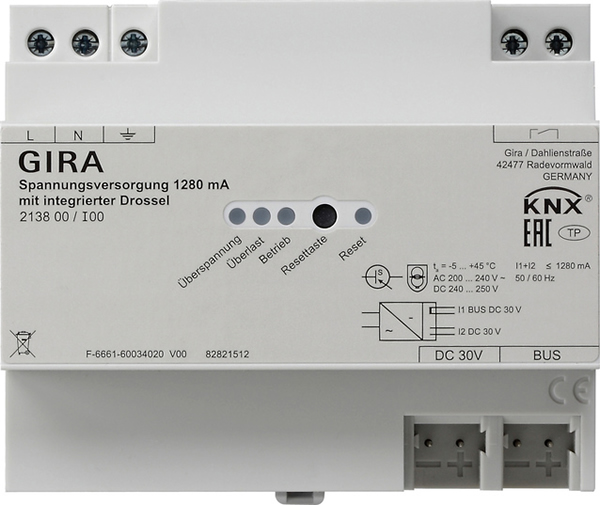
other hand, some manufacturers are now making a 1280mA PSU.
Bus
diagnostics
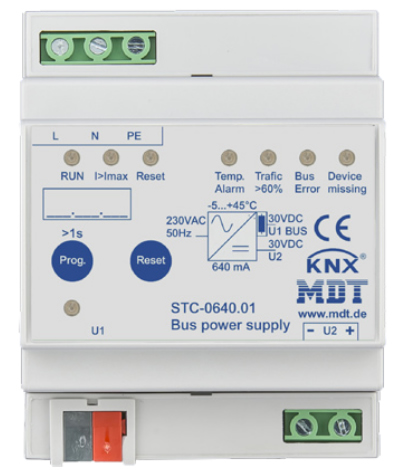
There are power supplies such as those from MDT, that will
output data such as bus voltage, current draw and overload via a telegram. That
could be extremely useful in determining faults or just general diagnostics so
that you can ensure that the bus is working within design parameters.
Uninterruptible power supplies and batteries
As the system grows, so should the concern for failures, and
the best way to prevent these is to add in a battery to ensure the bus always
remains healthy. There is a question as what equipment should continue to be
powered in the event of a total power failure, and at design stage, it's
worthwhile exploring scenarios around this idea. If the power to the house
fails, any safety and security devices should keep running, as should anything
that has logic modules or large chunks of control running on them. But there's
no point keeping all of the modules controlling the lights and heating online.
If the power failure is short-lived, they won't matter.
Conclusion
So, we haven't quite made it to the Tomorrows World of power
being embedded in the walls everywhere. Perhaps it's a timely reminder that as
KNX systems become ever easier to design and install, we should still remember
the basic principles of calculating bus load and being wary of loading too many
devices onto a single line, even though we can.
A 640mA PSU doesn't mean 64 devices, and likewise the 1280mA
PSU should not mean 128 devices. There is better practice than calculating bus
load in conjunction with the quantity of devices and then segmenting the system
accordingly. That is a basic system design principle that will ensure
tomorrow's world runs as reliably as it does today.
Simon Buddle CEng MIET, is a consultant for Future Ready Homes, a specialist in BMS and ELV services system design.