








Following its KNX Award win, what can the World’s Smartest Smart Home – a live research laboratory in Hamburg – teach KNX professionals about the future of intelligent building design?
Having picked up the KNX 2026 Smart Home Award for Europe, it would be a mistake to define this futuristic property as just another luxury residence.
Built and conceived over more than eight years, the villa is an extraordinary example of residential integration: 21 KNX lines support the installation’s network architecture, while more than 1,000 switching channels form part of a control system integrating everything from movable partition walls to switchable glass.
To put this into perspective, a typical family house might use only two or three KNX lines.

Scale is only part of the story: the property’s in-house development team – including the client – is studying it to investigate how networked buildings can better understand human activity while managing energy use.
Dr Thomas Lübbeke, founder of German integration firm and training provider CASAIO, leads the research.
“It’s a milestone for smart buildings, moving from purely technical functionality towards architecture that behaves adaptively, makes decisions, and responds individually to residents,” he says.
Lübbeke first encountered KNX as a student, when he experimented with a roll of green bus cable and ETS software to control a motion detector and bathroom fan.
Inspired by how much technology could improve daily life, he went on to establish CASAIO before writing the specialist book Your Way to the Smart Home.
“With intelligent data processing, we are more likely to live in buildings that make us feel comfortable without us being able to fully understand how or why,” he reflects.
“This represents a very different psychological model from the direct if-then relationship we’re used to when pressing a light switch, for example.”
Lübbeke’s work in system integration draws on his academic background in technical science, informatics and psychology, complementing the client’s knowledge of IT systems.
The circumstances point to some fascinating questions: how different is an intelligent building from a computer?
And, even more importantly, what role could KNX professionals play at the intersection of the two?
Where systems meet context
Integrating sensor and automation technology from manufacturers including Steinel, Elsner Elektronik and Gira, this house responds to information about human presence, activity and energy consumption across multiple systems.
These include sensor floors and microphone arrays, creating a contextual ecosystem spanning both physical and digital infrastructure: for example, LED panels provide intelligent illumination in the underground car park, while access control ensures that doors can only be opened externally with authorisation.

This combination of sensing and control is central to the home’s highly responsive automation, although Lübbeke highlights that intelligent buildings still need to explain themselves.
Citing his own research, he suggests that predictability is an important factor in the wider rollout of smart building technology: “If users do not understand that the blinds are blocked by a wind alarm, for example, and there is no explanatory user interface, confusion can arise very quickly.
“As a result, both trust in the technology and the enjoyment of interacting with it can quickly be lost.”
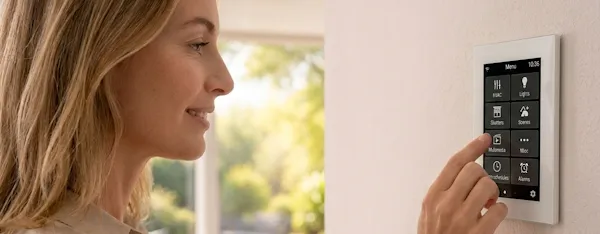
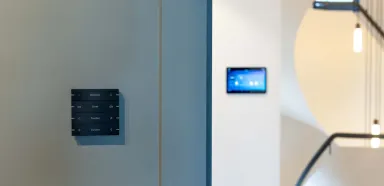
Voice control is used in the project alongside tactile interfaces to manage functions including lighting, shading and built-in speakers, either room by room or across entire floors.
This personalisation extends to the home’s soundscape, with at least one speaker in every room.

Connecting energy and comfort
The home’s open KNX system gives its research team the flexibility to explore new approaches to energy management and comfort.
In particular, the developers are interested in how different heat sources could be coordinated with thermal demands.
“We are thinking about how heat available at different temperatures, from sources like geothermal systems or server cabinets, can be matched to different needs,” Lübbeke says.
“For example, a swimming pool or sauna may require warmer water or a short burst of high-temperature heat at short notice.”
The project’s approach to comfort is not limited to temperature; its networked control architecture also integrates Modbus, DALI and DMX to create a similarly curated lighting environment.
“Human-centric lighting has shown that intelligent buildings can support biorhythms by using light level and colour temperature to follow aspects of the natural daylight pattern,” Lübbeke says.

“Although KNX already enables this, its potential remains underused in mainstream smart homes.
“But AI and better user interfaces are now making these benefits more accessible.”
More than 700 individually controllable DMX façade lights form part of the project’s lighting installation, while switchable glass manages privacy and creates the illusion of convertible space: in the app-controlled sauna, for example, glass surfaces can transition from clear to translucent at the touch of a button.
What comes next?
While these examples show how far the project’s flexible control philosophy can go, its scale remains an exceptional undertaking: more than 180km of cabling and 25 electrical distribution boards make it a very different proposition to a typical residential installation.
Perhaps the more relevant question for KNX professionals, then, is what role they could play in translating its main principles into more realistic applications.
Taking the project’s core themes into consideration, KNX integration extends beyond programming into design decisions across architecture, data flows and user experience.
“I also believe the ability to fully understand, logically configure, and manually commission such technical systems will become less important,” Lübbeke says.
“The next generation will likely expect intelligent data processing to translate those requirements into a working system.”
For those taking their first steps into KNX, Lübbeke points to his own progression from experimenting with the technology in his student apartment to delivering one of its most ambitious projects.
“Despite the development of AI processes, I still think working through problems by trial and error in ETS is one of the best ways to gain a detailed understanding of both the technology and its limitations,” he says.
“That knowledge is something we should continue to pass on to the next generation of integrators.
“And, combined with platforms like YouTube and the growing number of manufacturers on board, it’s possible to enter the KNX ecosystem far more quickly than was imaginable when I started 20 years ago.”