







The 16th KNX Awards celebrated outstanding projects, innovation and the global community behind smarter homes and buildings.
Behind every successful KNX project are people turning ideas into better buildings. The KNX Awards 2026 brought those people and their achievements centre stage, uniting the global KNX community for the 16th edition of the online celebration on 6 October. From smart homes and hotels to offices, public buildings and learning environments, this year’s winners showed how KNX professionals are tackling very different building challenges around the world. The Awards celebrate not only the technology, but also the knowledge, collaboration and community behind it.
Key facts
- 13 KNX Award winners recognised at the 16th KNX Awards
- Winning projects showcased solutions across homes, and buildings around the world
- KNX community selected the People’s Choice and Product Award winners
- Winners received a trophy, international exposure and €1,000 prize money
One community, diverse solutions
The international character of the KNX Awards was once again clearly visible in 2026. In Namibia, an entirely off-grid residence showed how KNX can provide reliable building control where conventional infrastructure is limited. In Melbourne, KNX controls lighting and automated shading in a 48-storey office development with more than 1,300 photovoltaic panels integrated into its façade. In Tokyo, the Innovation Award winner demonstrated how occupants can personalise lighting and airflow in a large office environment, while a historic public building in Spain showed how automation and renewable energy can support long-term sustainability. The projects differ in scale, purpose and location, but they all demonstrate the practical knowledge and experience of the professionals behind them.
A voice for the KNX community
The KNX community again played an active role during the ceremony. After live voting, the People’s Choice Award went to Tilal al Ghaf – Dubai by Huda Lighting. The KNX Product Award, which gives the KNX community the opportunity to vote for its favourite KNX device, was awarded to Iddero for Verso Q.
The wider community was also recognised through categories beyond individual building projects. The Education Award went to KNX Training House Poland, where a complete smart villa is used as a practical learning environment, while the Publicity Award recognised Torben Ledermann for making KNX knowledge more accessible through educational video content.
Celebrating the people behind KNX
What brings all these projects together is the expertise behind them. Planning, programming, integration and commissioning turn technology into buildings that perform as intended and can continue to evolve over time. That is also what the KNX Awards celebrate: not only the final result, but the people, knowledge and collaboration that make those results possible. Each KNX Award winner received a trophy, international exposure and a cash prize of €1,000.
For those who missed the live event, the KNX Awards 2026 ceremony can be watched on demand via the KNX Association YouTube channel.
KNX Awards 2026: The Winners
Smart Home Award - Africa, America, Australia: House J - Private Game Reserve by KNX Africa (Namibia)

Located on a remote game reserve in Namibia, House J demonstrates how smart home technology can deliver comfort and reliability even where conventional infrastructure is limited. The luxury residence operates entirely off-grid, making autonomous and dependable building control essential. KNX provides a decentralised foundation that keeps the home’s key functions operating independently of cloud services, while bringing together comfort, environmental protection and efficient operation in a solution designed for the demanding conditions of its surroundings.
Key features are:
- Integrated control of lighting, VRV HVAC, underfloor heating, curtains, sheers and blinds, bringing the home’s essential comfort functions together within the KNX system.
- A KNX weather station automatically responds to local conditions, including opening blinds during high winds and activating frost heaters when temperatures become critically low.
- DALI, Philips Hue, RTS and SAVANT are integrated with KNX, combining different technologies within one coordinated smart home environment.
- Presence-based lighting, personalised scenes and timed control of pumps and auxiliary systems help optimise energy use, while secure remote access supports reliable operation with minimal on-site intervention.
Smart Building Award - Africa, America, Australia: 435 Bourke Street Melbourne by bluebottle (Australia)

435 Bourke Street is one of Australia’s most advanced office towers, combining intelligent building control with an ambitious approach to sustainable workplace design. The 48-level development will provide 62,000 m² of premium office space for more than 5,500 workers, together with retail areas and a three-level sky garden. At the heart of the project is an innovative solar skin façade with more than 1,300 integrated photovoltaic panels, while KNX provides the smart technology backbone for lighting and automated shading throughout the tower. Together, these technologies support a highly efficient, comfortable and data-driven workplace designed around long-term building performance.
Key features are:
- A solar skin façade with more than 1,300 photovoltaic panels, generating up to 20% of the building’s electricity on site.
- KNX-controlled lighting and automated blinds support daylight optimisation, energy efficiency and occupant comfort.
- Every KNX datapoint is connected to the MSI platform for real-time visibility of lighting, blinds and system performance.
- Detailed building data supports continuous optimisation, predictive maintenance and ambitious sustainability targets.
Smart Home Award - Asia: NEXhome - Shanghai ITG & CRCC City Park by Fujian Nexhome Intelligent Technology Co.,Ltd. (China)

Shanghai ITG & CRCC City Park is a large-scale residential development in Shanghai that combines the reliability of KNX with an AI-driven approach to modern living. Designed as an adaptable and future-ready smart home ecosystem, the project connects private residences with wider property and community services while keeping everyday interaction simple for residents. Its open architecture also allows the system to evolve over time, making it possible to add new devices and services without replacing the underlying infrastructure.
Key features are:
- Centralised control of lighting, shading, HVAC, floor heating, fresh air and security, all built around a reliable KNX backbone.
- The 15.6-inch NEXhome EdgePad S acts as the smart control centre, combining local computing, multi-protocol compatibility and AI-based scenario management.
- A rapid configuration system enables deployment of each residential unit in around 15 minutes, supporting efficient implementation across a large-scale development.
- Residents can activate their smart home simply by scanning a QR code at move-in, while reserved interfaces and third-party integration support continuous upgrades and future expansion.
Smart Building Award - Asia: Novotel Madinah Hotel by Tera Systems (Saudi Arabia)

Novotel Madinah demonstrates how integrated building automation can support both guest comfort and efficient hotel operations in a demanding hospitality environment. KNX forms the foundation of a unified smart building platform that connects key technical systems across the property, allowing them to work together rather than as isolated installations. Centralised supervision, coordinated automation and real-time monitoring help simplify facility management while creating a more responsive and comfortable experience for guests.
Key Features are:
- Centralised integration of lighting, HVAC, energy monitoring, security, surveillance and low-current systems within one intelligent building management environment.
- Smart control of lighting, HVAC, curtains and room functions, with occupancy- and schedule-based automation helping reduce unnecessary energy consumption.
- CCTV and security systems are linked to the BMS for central alarm management, real-time monitoring and faster response to incidents.
- Integration with technologies including BACnet, DALI, Modbus, Zigbee and M-Bus demonstrates strong interoperability across the hotel’s different building systems.
Smart Home Award - Europe: The World's Smartest Smart Home by CASAIO GmbH (Germany)

This residential project in Hamburg explores how far intelligent living can go when building automation is designed as a complete, future-oriented ecosystem. Developed over more than eight years, the house goes far beyond conventional smart home functions by combining a dense network of sensors, tracking technologies and adaptive building systems. KNX provides the open and scalable foundation that brings these elements together, allowing the home to recognise presence, activities and context and respond proactively to the needs of its occupants.
Key Features are:
- Extensive KNX infrastructure with 21 KNX lines, more than 1,000 switching channels, 25 electrical distribution boards and over 180 km of cabling.
- Advanced sensing technologies including sensor floors, 3D object recognition, person tracking and microphone arrays, enabling the building to understand activity and context.
- Integration of DALI, DMX, Modbus and other technologies through KNX, creating one coherent platform for highly complex building functions.
- Innovative comfort features including Human Centric Lighting, switchable glass, movable partition walls, invisible loudspeakers and more than 700 individually controllable DMX façade lights.
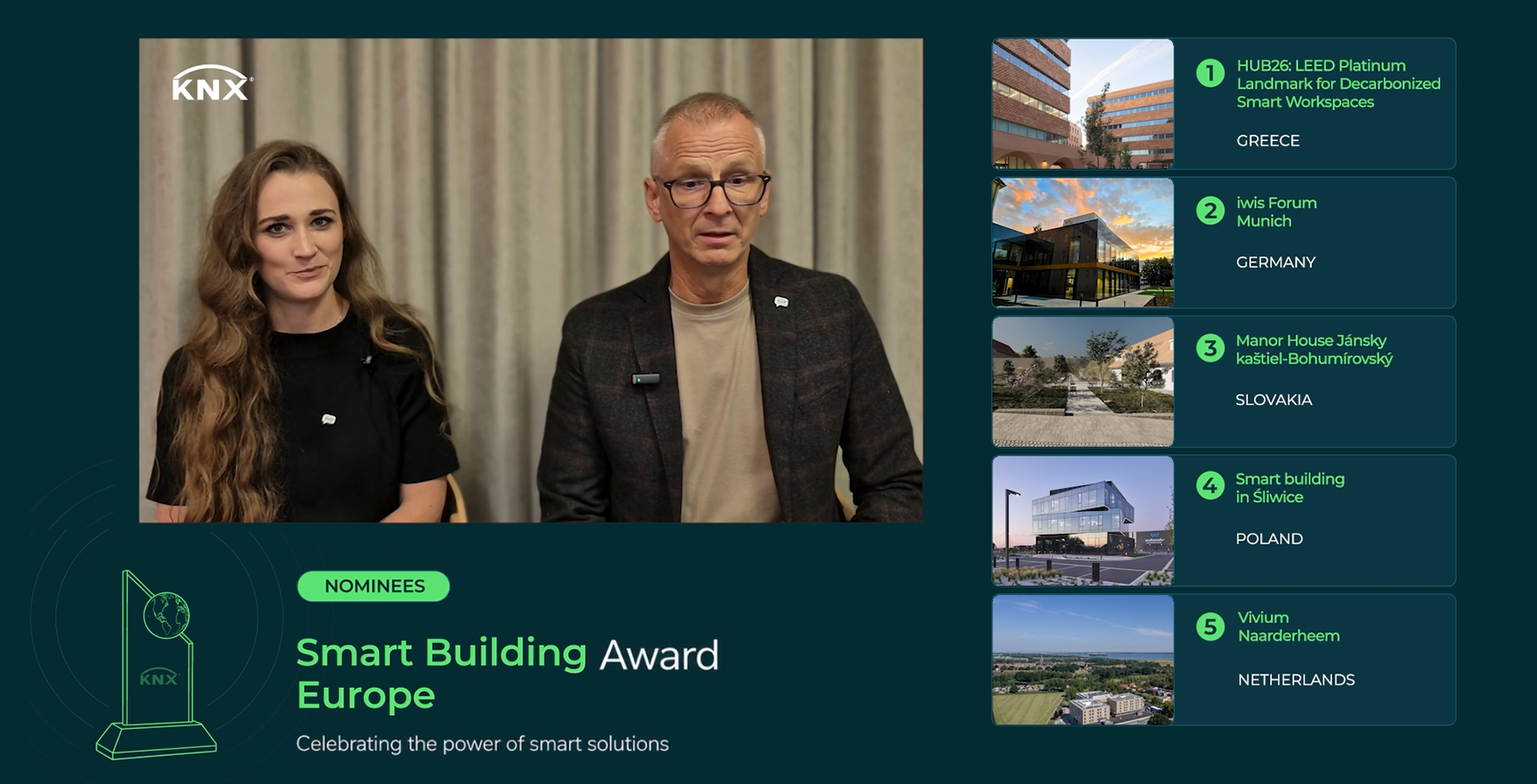
Smart Building Award – Europe: HUB26: A KNX-Driven LEED Platinum Landmark for Decarbonized Smart Workspaces by Charalampos Triantafildis & SIA O.E (Greece)

HUB26 is Northern Greece’s first large-scale bioclimatic business park, bringing 31,000 m² of modern office space together in a highly integrated smart building environment. Located in Thessaloniki, the four interconnected building blocks use KNX as the backbone for coordinated building operation, supporting the project’s ambition to achieve LEED Platinum certification. By combining centralised management with responsive local control, the system creates comfortable working conditions for multiple tenants while continuously adapting building services to actual demand.
Key Features are:
- A central KNX visualisation platform provides facility managers with real-time insight into energy consumption, device status and system faults across all four building blocks.
- Intelligent daylight harvesting automatically adjusts lighting according to available natural light, maintaining optimal workplace illumination while reducing lighting energy consumption by up to 40%.
- Presence-based automation switches unoccupied areas into energy-saving HVAC modes, while CO₂ monitoring enables demand-controlled ventilation according to actual occupancy and indoor air quality.
- Automated schedules coordinate lighting and HVAC throughout the day, including energy-saving night modes and pre-heating or pre-cooling before working hours.
Sustainability Award - Plaza de España Building by IKNX Engineering (Spain)

The renovation of the historic Plaza de España Building in Rota demonstrates how sustainability can go hand in hand with the preservation of cultural heritage. Rather than replacing the existing structure, the project gives the former Town Hall a new life as a modern, accessible and energy-efficient public building while carefully integrating the remains of the Almohad city wall. KNX-based automation forms part of a wider strategy that combines responsible resource use, renewable energy and long-term building performance, creating a bridge between Rota’s history and a more sustainable future.
Key Features are:
- More than 30% energy savings through a combination of improved insulation, photovoltaic generation and geothermal heating and cooling.
- KNX works alongside DALI-2, Modbus, BACnet and M-Bus within a central BMS, enabling coordinated control and continuous optimisation of lighting, HVAC, energy and water consumption.
- Real-time monitoring, reporting and historical energy analysis provide the data needed to identify inefficiencies, verify savings and support evidence-based building management.
- Public information displays make energy consumption, photovoltaic production and geothermal performance visible to citizens, turning the building itself into a tool for transparency and sustainability awareness.
Innovation Award: Human-Centric Smart Office: Tailored for Every Occupant by Matt & Massimo (Japan)

This 18,000 m² office building in central Tokyo introduces a new approach to the shared workplace, combining personal comfort with efficient building operation. Designed for the post-pandemic working environment, the project uses KNX as the foundation for a highly responsive and scalable control concept in which each occupant can adapt their immediate surroundings. The result is a human-centric workplace where building technology responds naturally to individual needs while supporting wellbeing and responsible energy use.
Key Features are:
- NFC-based personalisation allows users to identify their workstation and immediately control individual task lighting and airflow through a custom smartphone app.
- A distributed architecture with dedicated floor servers processes user commands locally for virtually instant response, while a central server manages building-wide scheduling and energy data.
- Human-centric lighting follows circadian rhythms to support occupant wellbeing, while motion-based automation helps minimise unnecessary energy consumption.
- IP-native APIs seamlessly connect the KNX infrastructure with a bespoke IoT application, demonstrating how KNX can support highly personalised control at the scale of a major commercial building.
Publicity Award: Easier Access To KNX by Torben Ledermann (Germany)

With his YouTube channel, Torben Ledermann provides a practical and accessible gateway into professional building automation. The channel makes KNX knowledge freely available to a wide audience through clear explanations, real-world applications and hands-on demonstrations. Covering both fundamental concepts and current developments in smart building technology, the content helps lower the barriers to getting started with KNX while increasing awareness of open and manufacturer-independent building automation.
Key Features are:
- Free learning content in both German and English, making practical KNX knowledge easily accessible to a broad international audience.
- Real-world project examples, product demonstrations and practical explanations that translate professional building automation into understandable everyday applications.
- Broad coverage ranging from KNX fundamentals, lighting, shading and energy management to integrations with DALI, Modbus, Thread, Zigbee and Home Assistant.
- Manufacturer-independent content combined with current industry developments, helping inspire and prepare the next generation of KNX professionals.
Special Award: Three Buildings, One Intelligence by Būsto Automatika (Lithuania)

Three Buildings, One Intelligence is a residential project in Vilnius that shows how KNX can bring a complex estate together as one coordinated smart environment. Three separate buildings are connected through a unified automation system, giving residents consistent and intuitive control across the entire property. KNX provides the reliable backbone while working alongside additional technologies for visualisation, entertainment and specialised functions, demonstrating the flexibility of an open system even when requirements go far beyond conventional home automation.
Key Features are:
- A custom KNX-based solution controls the height of a motorised basketball hoop, combining a three-phase motor, frequency converter and outdoor KNX RF controls.
- KNX IP connects the three buildings, while KNX TP and KNX RF provide flexible communication within the individual buildings.
- Comprehensive control of lighting, shading, HVAC, underfloor heating, security and jacuzzi functions across the estate.
- Integration with SAVANT for visualisation and audio/video control, complemented by custom IoT solutions for devices and functions outside the standard KNX environment.
Education Award: KNX Training House Poland by Centrum Szkoleniowe Automatyki Budynkowej KNX (Poland)

KNX Training House Poland in Wrocław turns KNX education into a fully immersive, real-world learning experience. Instead of working only with traditional training boards, participants learn in a complete smart building environment where they can program, test, measure and optimise actual building functions. The project brings together professional training, practical experimentation and research in one open, multi-brand KNX ecosystem, helping students, installers and professionals develop the skills needed for the smart buildings of tomorrow.
Key Features are:
- A fully operational 300 m² smart villa that serves as a live teaching environment for certified KNX training, practical diagnostics and real building scenarios.
- More than 500 KNX devices across 8 advanced workstations, complemented by specialist stations and compact training sets for different learning levels.
- Hands-on training across applications including DALI, HVAC, shading, security, visualisation, PV, battery storage, EV charging and smart metering.
- Future-focused experimentation with IoT, Raspberry Pi, ESP and Arduino microcontrollers, together with AI-based analytics for analysing and optimising building data.
People’s Choice Award: Tilal al Ghaf - Dubai by Huda lighting (United Arab Emirates)

Tilal al Ghaf is a large luxury residential community in Dubai where KNX brings together comfort, security and everyday convenience across a comprehensive smart home environment. The installation integrates lighting, climate control, shading, security, intercom and entertainment functions within one connected system, giving residents intuitive control both at home and remotely. With an open KNX foundation and more than 1,000 KNX devices across the project, the solution combines extensive functionality with the flexibility to integrate different technologies and adapt to individual homeowner preferences.
Key Features are:
- Integrated control of lighting, air conditioning, blinds, security, intercom, audio/video and other home functions from one smart home environment.
- Mobile and remote access allows residents to control their home functions from virtually anywhere.
- More than 1,000 KNX devices support automation across the large-scale luxury residential project.
- KNX’s open architecture enables integration with other systems and gives homeowners flexibility in the choice of products and functions.
KNX Product Award: Verso Q by Iddero (Spain)

Iddero VERSO Q is a KNX room controller that shares the same design DNA as the Iddero VERSO 2 (PLUS X Award for Best Product of the Year 2024) and VERSO+IP 2 (KNX Award for Best KNX Product of the Year 2024).
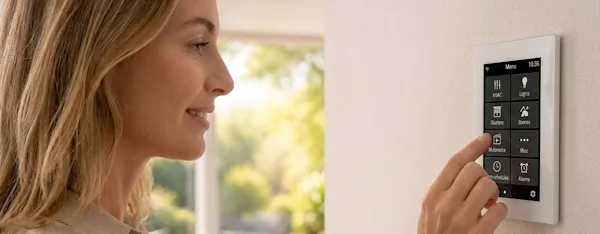
This new touch panel features a compact design built around a 3.5” capacitive multitouch display. Smaller in size, but BIG where it matters: touch gestures, 6 fully configurable pages with up to 6 controls per page and flexible layout options, light and dark UI themes, dual thermostat function with built-in temperature probe and optional humidity sensor, time schedules, alarms, four multifunction inputs, and direct connection to the KNX bus (TP1).
VERSO Q is available in white or black GLASS finishes..
https://www.iddero.com/en/products/verso-q
Sign up for more press updates
If you wish to receive our press releases directly by email, please sign up to our KNX Press List